Thursday, 1 September 2016

Haute Day 5: 7 hours of joy, one hour of pain

Actually from yesterday (Galibier) but the official photos are much better than mine.
Watch the fabulous video of the day here

Day 5 always looked the toughest. It is 4,200 metres of climbing and four ascents. The highlight is the Col de Madelaine, which first appeared in the Tour in 1969 and has featured 25 times since, always as the top “hors categories”. Jan Ullrich won here in 98, the year after his Tour victory, and the last winner was the French Pierre Rolland in 2013.

These are not just mountains. These are places of cycling history. And there are some amazing endurance athletes taking part. There are actually three Haute Route events, each a week long: The Pyrenees, the Alps and the Dolomites.

There are people here who are taking part in all three, with just a single rest day in between for travel. Given that only half the Tour de France stages are in the mountains, but all the Haute Route ones are, this means those folks are on a greater endurance test than the professionals – especially those going fast at the front.

Over breakfast I mention my approach of talking my way to the top. “No”, responds Toby, “for me it’s the solitude of the mountains, thinking my thoughts and going at my own pace”.

We set off with the song “Celebration Time” ringing in our ears, move up a small 500ft climb, the Telegraph, and descend together. As the timing starts, everybody accelerates and long trains of cyclists start to go past. This is basicly the first flat section we have had on our travels. I get on the back of a train and it is exhilarating, carried along at speed, though it does take effort. I notice a speed limit notice of 50kph. I look at my speedo and see we are doing 63.

Yes,w e went up there
We leave the road and start an ascent of seventeen hairpins. Seventeen! It is basicly a road straight up a cliff. I wonder why anybody would build such a thing. In England we would say “just go round it”.

On this ascent, the markers tell you the % gradient of the next kilometre. “Are you kidding me?”, exclaims Mia from Australia, whose wheel I have attached myself to for this climb as we see a 13%. But somehow it doesn’t seem too difficult.

The scenery is again incredible. At one point the road is dug out of a vertical cliff, with a 1000 ft precipice off the edge. And I find myself not talking but taking some time to contemplate. After my odd experience yesterday of becoming a “social media phenomenon” there is a lot to reflect on. 

My gillet (which I need for the cold descents) falls out of my back pocket and my fellow cyclists alert me. I stop and get ready to turn back to get it but then hear that distinctive Australian twang: “Henry, you dozy bastard”. John has picked it up and brings it up to me. My saviour again.

As we rise up the Col de Chaussy I find myself so lost in my thoughts and the splendour of the views, that I’ve lost track of the kilometres. When I see one saying it is just 3km to the top I almost respond “Oh, couldn’t it be more”. Almost, but not quite. But maybe this "solitude of the mountains" stuff has a point.

I get to the top feeling good. But caution myself that I felt great at the first peak, Turino, on Sunday and look what happened then. But the second climb, the mighty Madelaine, feels even better. I am moving past others as I spin, spin, spin. The sun is out but it feels like a gentle English summer, just perfect for cycling.

But a sudden concern is that I forgot to put on sunscreen and will burn badly if I am out all day without it. We pass the race doctor but she has no cream.

On the last km, a 9% ascent, myself and Clayton (an anaesthethist from Vancouver) take turns on each other wheel and then have a race to the summit. I am pipped at the post but it feels great to have the energy to do that.

As we approach the food stop I see a man standing there holding a tube of suncream. It is John. That man comes to my rescue again. How does he do it?

There is a very attractive café off to the side. I am 50 minutes ahead of cut-off and do consider it, especially as we are now between timing zones (they often don’t time the descents, to avoid dangerous behaviour). But it would be tempting fate.

The 25 km descent is glorious, down a wooded valley with snow-covered peaks towering above. I find out that Graeme, from St Albans, lived across the road from me for 8 years and we never met. But neither of us were seriously into cycling then.

We now head up a curious route. It isn’t an official col, wasn’t really included in the briefing and has no distance markers. But it turns out to be a 600m climb in the now intense heat. It is a detour that is entirely unnecessary. “The organisers are sadists”, I suggest to Andre (from Brazil) as we cycle on. “That is true”, he agrees “But we are masochists”.

I have now been over 7 hours in the saddle and am running out of energy. I pull into the 4th foodstop, ignore the healthy bananas and and take a couple more of the chocolate snack bars that have become my favourite bite. Strava (the cycling app) tells me I’m using up 5,000 calories on each ride and they need replacing.

“Henry, you should water the flowers”, Toni (from Finland) shouts out as he passes, 6 km from the top. “Pardon?”. “You have two full water bottles and you are almost finished. Empty one, it will slow you down.” I water the flowers.

I mention this to somebody later. “You took two full water bottles on the last ascent”, he responds. “You are mad.” Is this obsessive? I see somebody cleaning their bike and comment on how impressive this is to do in the middle of the week. “Ah, if you clean off the dirt, it is lighter.” Wow. Am I taking this event seriously enough?

I have made it with 15 minutes to cut-off. I feel exhausted and a little sick. Perhaps the 8th chocolate bar was a mistake. Asked by Neil, of the British Omani team, how it went I say “7 hours joy, one hour pain.”

On Sunday afternoon I sat under a tree, devastated and wondering if I would be able to finish any of the stages. As I agreed to pull out for that day, I was in tears. Now I do feel like a man transformed. The last hour was tough but I felt strong through most of this toughest of races.


I wonder what my family will think if I suggest the full three weeks?

See also Day 1; Day 2; Day 3; Day 4; Day 5; Day 6; Day 7
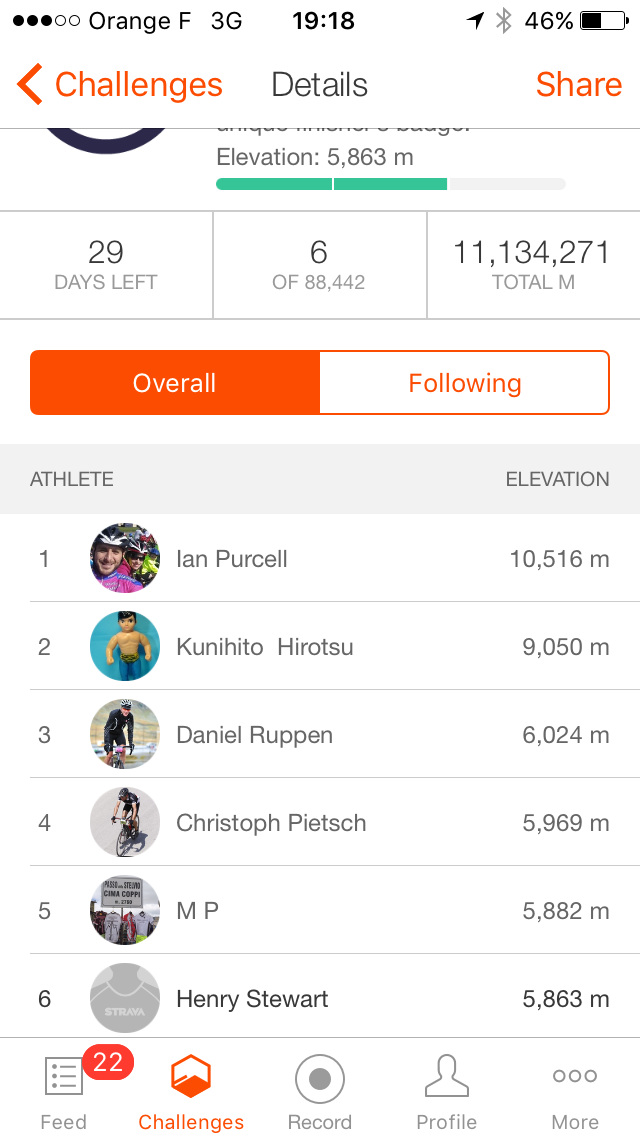
Am very excited by this. On the Strava September cycling climbing challenge, after today, I am 6th out of 90,000!! (Yes, I know its only been one day)

Haute Day 5: 7 hours of joy, one hour of pain

Actually from yesterday (Galibier) but the official photos are much better than mine.
Watch the fabulous video of the day here

Day 5 always looked the toughest. It is 4,200 metres of climbing and four ascents. The highlight is the Col de Madelaine, which first appeared in the Tour in 1969 and has featured 25 times since, always as the top “hors categories”. Jan Ullrich won here in 98, the year after his Tour victory, and the last winner was the French Pierre Rolland in 2013.

These are not just mountains. These are places of cycling history. And there are some amazing endurance athletes taking part. There are actually three Haute Route events, each a week long: The Pyrenees, the Alps and the Dolomites.

There are people here who are taking part in all three, with just a single rest day in between for travel. Given that only half the Tour de France stages are in the mountains, but all the Haute Route ones are, this means those folks are on a greater endurance test than the professionals – especially those going fast at the front.

Over breakfast I mention my approach of talking my way to the top. “No”, responds Toby, “for me it’s the solitude of the mountains, thinking my thoughts and going at my own pace”.

We set off with the song “Celebration Time” ringing in our ears, move up a small 500ft climb, the Telegraph, and descend together. As the timing starts, everybody accelerates and long trains of cyclists start to go past. This is basicly the first flat section we have had on our travels. I get on the back of a train and it is exhilarating, carried along at speed, though it does take effort. I notice a speed limit notice of 50kph. I look at my speedo and see we are doing 63.

Yes,w e went up there
We leave the road and start an ascent of seventeen hairpins. Seventeen! It is basicly a road straight up a cliff. I wonder why anybody would build such a thing. In England we would say “just go round it”.

On this ascent, the markers tell you the % gradient of the next kilometre. “Are you kidding me?”, exclaims Mia from Australia, whose wheel I have attached myself to for this climb as we see a 13%. But somehow it doesn’t seem too difficult.

The scenery is again incredible. At one point the road is dug out of a vertical cliff, with a 1000 ft precipice off the edge. And I find myself not talking but taking some time to contemplate. After my odd experience yesterday of becoming a “social media phenomenon” there is a lot to reflect on. 

My gillet (which I need for the cold descents) falls out of my back pocket and my fellow cyclists alert me. I stop and get ready to turn back to get it but then hear that distinctive Australian twang: “Henry, you dozy bastard”. John has picked it up and brings it up to me. My saviour again.

As we rise up the Col de Chaussy I find myself so lost in my thoughts and the splendour of the views, that I’ve lost track of the kilometres. When I see one saying it is just 3km to the top I almost respond “Oh, couldn’t it be more”. Almost, but not quite. But maybe this "solitude of the mountains" stuff has a point.

I get to the top feeling good. But caution myself that I felt great at the first peak, Turino, on Sunday and look what happened then. But the second climb, the mighty Madelaine, feels even better. I am moving past others as I spin, spin, spin. The sun is out but it feels like a gentle English summer, just perfect for cycling.

But a sudden concern is that I forgot to put on sunscreen and will burn badly if I am out all day without it. We pass the race doctor but she has no cream.

On the last km, a 9% ascent, myself and Clayton (an anaesthethist from Vancouver) take turns on each other wheel and then have a race to the summit. I am pipped at the post but it feels great to have the energy to do that.

As we approach the food stop I see a man standing there holding a tube of suncream. It is John. That man comes to my rescue again. How does he do it?

There is a very attractive café off to the side. I am 50 minutes ahead of cut-off and do consider it, especially as we are now between timing zones (they often don’t time the descents, to avoid dangerous behaviour). But it would be tempting fate.

The 25 km descent is glorious, down a wooded valley with snow-covered peaks towering above. I find out that Graeme, from St Albans, lived across the road from me for 8 years and we never met. But neither of us were seriously into cycling then.

We now head up a curious route. It isn’t an official col, wasn’t really included in the briefing and has no distance markers. But it turns out to be a 600m climb in the now intense heat. It is a detour that is entirely unnecessary. “The organisers are sadists”, I suggest to Andre (from Brazil) as we cycle on. “That is true”, he agrees “But we are masochists”.

I have now been over 7 hours in the saddle and am running out of energy. I pull into the 4th foodstop, ignore the healthy bananas and and take a couple more of the chocolate snack bars that have become my favourite bite. Strava (the cycling app) tells me I’m using up 5,000 calories on each ride and they need replacing.

“Henry, you should water the flowers”, Toni (from Finland) shouts out as he passes, 6 km from the top. “Pardon?”. “You have two full water bottles and you are almost finished. Empty one, it will slow you down.” I water the flowers.

I mention this to somebody later. “You took two full water bottles on the last ascent”, he responds. “You are mad.” Is this obsessive? I see somebody cleaning their bike and comment on how impressive this is to do in the middle of the week. “Ah, if you clean off the dirt, it is lighter.” Wow. Am I taking this event seriously enough?

I have made it with 15 minutes to cut-off. I feel exhausted and a little sick. Perhaps the 8th chocolate bar was a mistake. Asked by Neil, of the British Omani team, how it went I say “7 hours joy, one hour pain.”

On Sunday afternoon I sat under a tree, devastated and wondering if I would be able to finish any of the stages. As I agreed to pull out for that day, I was in tears. Now I do feel like a man transformed. The last hour was tough but I felt strong through most of this toughest of races.


I wonder what my family will think if I suggest the full three weeks?
Am very excited by this. On the Strava September cycling climbing challenge, after today, I am 6th out of 90,000!! (Yes, I know its only been one day)

Wednesday, 31 August 2016

Haute Day 4: In the first 30 to top Galibier

Ok, that title is an entirely misleading statement but it was so nice to write. Today was a time trial and so, just as in the Tour, the slowest riders went first with a 20 second gap between each one. I was in the first 30 riders to leave Valloire. By the time I got to the top, most of the faster riders hadn’t even started.

Today was just one climb. After three days of ascending half the height of Everest each day, this is almost a rest day. The 1,250 m (4,130 ft) climb is a little less than Ben Nevis, Britain’s highest mountain.

But it is still the mighty Galibier and my aim is to get there in under 2 hours. Its all in the mind, I say to James over breakfast. I know from the final ascent on Day 2 that my body is capable of more than my mind sometimes wants to do.

Though it was a weird start to the day. I awoke to a text from my daughter: “Dad, you’ve gone viral in Cambodia.” Surprisingly this was not people eagerly reading this blog. A letter I wrote on the train down, about burkinis and men in suits, was published in the Guardian yesterday and seems to have a got a lot of attention.

Off the ramp
Anyway, we start off a ramp just like in the Tour with people shouting our name. Just fabulous. And with a rider 20 seconds each side of you, the competition is on. When I am out riding and see a cyclist ahead of me I accelerate to catch them up. I don’t have to think about it. Its automatic, like breathing. And on this climb there is always a cyclist ahead of you.

Today is an individual pursuit, its you and the mountain and there seems little chance for the chats that got me up the Galibier yesterday. It is 18 km in distance. I only need to average above 9 kph to beat that 2 hours. With nobody to talk to, I find myself doing a lot of “stem watching” (checking my computer to ensure I’m above that speed).

Every kilometre on this, and all French cycling climbs, there is a marker with the distance to the peak and the current altitude. You develop almost an obsession with when the next one will be, when you are 1 km closer.

I reach the half way marker in 45 minutes and as it flattens out a little, Andrew from Surbiton comes past. “Can I get on your wheel?” I ask. “Drafting” would not be allowed in the Tour and the rules are unclear here. “Fine by me” says Andrew and I speed up to 10 mph with little extra effort. We take the turn to the start of the steep ascent and I hold onto the wheel for a few minutes but he is too strong.

Is it just me or are the right-hand hairpin turns always a bit easier? My mind is convinced of it and I always manage to put in some extra speed after the turn.

I also see now the point of power meters. Serious riders (including many on this race) use them. In the gym they find their potential power output and then they can compare what the meter reads as they go uphill, to what they know their body can do. Those figures must be a very a powerful antidote to the message from the mind that you are doing all you can.

Gareth from Guildford (Andrew’s cycling buddy) reaches me on the 9% inclines and we stick together for a while. Finally another person to talk to. “Spin to win” was the advice I heard shouted a month ago as we went up Leith Hill (a mere 320 metres, but the highest hill in South-East England) on the London Ride100. I remember changing down to an easier gear and speeding up, and passing the other cyclists.

The trick is not to push those pedals but instead to be in a gear where you can simply spin them at a high cadence. “Spin to win” I keep telling myself and manage to keep up with Gareth as we pass 7 km, 6km, 5km.

"It says 3. It really does"
“3. It says 3 km” I shout as I see the marker, wondering if I am hallucinating. “It can’t be, its wrong”, he says. “It does, it says 3” We have been so happily occupied discussing the gentrification of Hackney (where I live) and completely missed the 4km marker. It is hard to describe the sheer joy of that moment.

Another kilometre and an organiser shouts “2km to go”. But what a 2km. It looks vertical with nine hairpin bends, although it is actually an average 10% ascent. And, of course, half of them are the easy right-hand ones.

I feel fresh. I feel good. We are not yet at 90 minutes. A very fast cyclist reaches me, but we are on a right-hand bend and I accelerate holding him off for 25 metres. If only I could persuade my mind that every ascent is as easy as the right-hand ones.

Yes, we came up that way
The col is in sight, I manage to hit 14 kph on the 9% final stretch and am absolutely elated to be, once again, on top of the world, and to have done it in 1 hour 42 minutes. There is joy on all sides as we share the moment, have photos holding our bicycles in the air (slightly harder for me, as mine seems to be heavier than everybody elses).

Every club cyclist knows that any decent ride includes a café and cake. Sadly in the Route the rush is always on to either get a good time or finish. Today is gloriously different. We are only timed on the ascent and so coming down we stop at an alpine bar. We sit among the most beautiful scenery you can imagine, stunning peaks on every side, sip our coffees and hot chocolates and watch the faster riders go past.

With Andrew and Gareth at the post ride cafe
This is a place of history. Gareth points out the bridge where Pantini launched his famous break in 1998 to take the stage. We may not have gone anywhere near his pace but we climbed those same roads. It is a great honour to, in two days, have climbed both sides of the great Galibier.

Where did I actually come in today’s ratings? Number 354 out of 390. I’m happy with that. The fastest cyclist somehow did that climb in 53 minutes. Unbelievable.


I retire to our chalet (the delightfully named “la joie de vivre") in Valloire to discover my burkini letter is on Mashable, Huffington Post and all over twitter and facebook. Life is strange. 

See also: Day 1; Day 2; Day 3; Day 4; Day 5; Day 6; Day 7; Reflections

Monday, 29 August 2016

Haute Day 3: On top of the world

For a real sense of the day, and especially the scenery, check out the Haute Route video. And you can see me in the video (at the end) from yesterday.

Day 3 of the Haute Route could be a little easier than the previous ones. There are just two peaks, though they are Tour de France classics: the 2,360 metre high Col d’isourd and the 2,645 metres Gallibier.

The Galibier was first used in 1911 and on the 100th anniversary in 2011 was won by Andy Schleck after an incredible 60 km break away. A fellow cyclist here reckons it was the most exciting Tour de France stage ever, almost enabling Schleck to take the title from Cadal Evans [in the last year when British riders weren't favourites to win]. The Col d’Isuard was last climbed in 2014 when the Spaniard Joaquim Rodriguez won it.

After two days of blistering sunshine, we are told to prepare for storms. They expect rain from 11am, temperatures of 10 degree and possible ice on the descent from the first peak. The key is to get to the Isourd by 10.30 to have a safe and non-slippery descent.

I am wearing or carrying my thermal overshoes, winter jacket, gilet, waterproof top and full waterproof gloves. I feel a bit overloaded but very well prepared.

Friends back home have asked if its painful. Now it may be for those riding at the front. Somebody on the next massage table to mine today commented “it hurts every day, just in a different part of the body”. I’m not in pain, just battling the exhaustion.

The key is the search for the perfect gear. For me every ascent has a gear that is just right. When you get there, you know it. You feel in tune with the rhythm of the mountain and just able to go on and on.

The aspect that makes the Haute Route difficult is the cut off times. For me and those around me, they are tight. You know when you are in danger when the “Lantern Rouge”, a cyclist in a red top bringing up the rear, comes in sight. If you don’t make the cut-off time you are out for that day. Today it is 7 hour 10 minutes for 74.3 miles and 13,610 ft of climbing.

The Haute Route organisers has made sure every rider has their name, flag and team name on their back. It makes it so easy to start a conversation with total strangers and I love it. My cycling mate Alan and me reckon that climbing ascents is so much easier if you talk all the way up.

Oddly not everybody feels the same. As we near the top, reactions include “I’m in the zone” or even “I’m meditating” or "Sorry, I can't ride and breath and speak". But I while away the first hour with a discussion with Sophie, who helped her company win best workplace in the UK and now runs www.challengesophie.com to encourage women (and men) to become more active.

Atop L'Isourd with james
But it is hot. And, like most around me, I am regretting my winter top. Drink more water, I keep reminding myself. I don’t want to dehydrate again. After a 2 hour, 27 mins climb we get to the top of L’Isoard. There is no sign of rain, so there is a glorious descent through stunning alpine scenery.

As we come out of Briancon, we start a long 25k drag up to Lautaret. The advice was to become part of a group but it is me and James on our own. Then a beautifully attired group in blue and yellow, sporting the ‘HC Cycling’ tag come by. “Allez, Henry” one shouts, reading the name on my back. 

They are not even part of the Haute Route, but a group of Romanians on their own 7 day cycling tour.
We jump on and join their group, discussing Romanian cycling peaks, Top Gear and Jeremy Clarkson (there is a connection between these). For 10 km we are swept along in their slipsteam, taking us out of danger on time. Thank you, Romania. And thank you again for cycling comraderie. We reach Lautaret with 15 minutes to spare.

Only 5 miles from here
“Is that almost the top?”, I ask pointing up to where the road turns a corner a fair bit up. “Er, no, not quite. Its up there,” comments the guy on the feed station, pointing to a far and distant peak. “But its only five miles.”

I look down and see the Lantern Rouge coming up the valley behind, leading a group of four. It Is time to set off. I find myself with John, my saviour from yesterday. It is again an 8km ascent and we decide to go up again together. “But not like yesterday. That wiped me out.”

We came up that way
We have an hour and discuss everything from Australian Prime Ministers to whether Corbyn is the best leader for the British Labour Party (we don't agree on this). As we ascend steadily upwards and look round at the peaks and alpine valleys, he comments “this is the weirdest place I’ve ever had a political discussion.” But it takes us to 1km from the top, before that final effort.

What could be better than a steady cycle up a Tour de France classic col, stunning scenery on all sides while discussing the state of the world? 

We did it. We made it up the two classic peaks still with 10 minutes to spare. I feel elated, and on top
of the world – in more senses than one. To finish, there is only a 16 km descent to Valloire. I am exhausted but feel good, the first day I didn’t feel in danger of ending up in the "bus".

As we ascended I longed for the promised rain. Instead it was sunny, 23 degrees and I was still in my winter cycling jacket. But it does prove rather useful on the cold, cold descent in the shade from Galibier.

Tomorrow is the “rest day”, just one climb – back up to the top of Galibier, a 1,300 metre ascent in a time trial. But no cut-off so I am safe until Thursday, the toughest day of the week.

See also: Day 1; Day 2; Day 3; Day 4; Day 5; Day 6; Day 7; Reflections
The monument tot he founder of the Tour, below Galibier

Haute Route Day 2: 2nd highest road in Europe

The second day of the Haute Route involved three fierce cycling climbs, including La Bonette. The organisers say this is the third highest road in Europe but Google puts it at No. 2. 

Oddly, it has only appeared four times in the Tour de France, the last time in 2008. However it was the scene of a then rare British victory for Robert Millar in 1993.

I have to admit I was nervous, having had to drop out towards the end of Day 1. Was it just that I hadn’t drunk enough water or had I perhaps not put in enough training or simply am not up to “the highest, toughest cycle sportive in the world”?

Chatting to others it was clear that nobody had found it easy. “Mental torture” and “in terms of suffering, it was in a league of its own” were among the comments.

So we put together a plan. Team Happy consists of me, James and Toby and our aim is simply to finish. We leave the fastest times to the others. Toby had proved himself the strongest cyclist on the first day, being the youngest in the team at just 49. So Toby would lead us up la Bonnette and we would hang onto his wheel. We would cycle together as a team until the point where we were in danger of missing the cut off time, and then it would be okay to go on alone.

La Bonnett: The View Down
And the ride up La Bonnette - up through the valley, round a dozen hairpin bends, through an abandoned military outpost and onto the moonlike landscape at the top – was a joy. It is remarkable how the psychological will to hang onto a wheel can help you up the longest climb.

It was huge boost to get to the top with a half hour gap to the cut off time. It was the biggest climb I’ve ever done at 5,000 ft of ascent, more than the 4,000 ft of the Tourmalet in the Pyranees for which I had to stop many times. La Bonnett was without a break, a climb of 2 hours 14 minutes.

On top it felt like we were on top of the world, at just under 9,000 ft. Amazing views of the Alpine peaks, and picture book villages. Some of the best views I’ve ever seen.

The 20km descent was another delight. I’m definitely getting the hang of long descents and kept with my team today. Though the sound of an ambulance siren behind us did bring a note of caution and visibly slowed all the cyclists around me. [We later found out that a cyclist had hit a motorcyclist, coming the other way, head-on. He continued and finished the course, before being taken to hospital and being found to have several broken ribs.]

As we set off up the valley from the feed station we formed into a 40 strong peloton and sped along effortlessly though the stunning valley scenery. James, who had got little sleep last night was struggling and me and Toby had a quick consultation on times. The cut off time was tight but not desperate so we resolved to guide James up the col.

We came to what had been described as the “brutal” last 5 km of the Vars, at an average 10%. We ascended at 7kph, as did those around us. It was a sobering thought that the summit was just 5km away but would take us 45 minutes to reach, with the sun blazing down. I took the lead for this climb. Going at a slower pace than I could have, made it a bit easier.

With 1km to go to the top a nice lady from Haute Route, by the side of the road, made an unexpected offer: “water on the head?”, she asked. At that moment I could think of nothing in life that would give me greater pleasure than a bottle of water poured through my helmet. I accepted eagerly, and swear it sped me up by 25% on the final ascent.

More beautiful views but no time to waste. Another marvellous descent and then the final climb. We had one hour to make 900 m of ascent. For comparison it had taken 2 hours 14 minutes for the 1,500 m of La Bonnette, and that was when we were fresh. With 8km to go I had to rest at the refreshment point. I doused myself in water and drank lots.

That chimp inside my head was telling me that I’d done enough, that I should get in that nice bus that would be coming along shortly. Success or failure is so much about getting your head straight.

My saviour, John
And then along came John from Australia, who I’d not met but was to be my hero, my good Samaritan.

“They’ve given us another 15 minutes”, he said. “That’s still 8km in 30 minutes, up an 8% slope, in 30 degree heat”, I responded. Hey, I was tired. “Let’s give it a crack”, he said and off we set, me following his wheel. 

Every time I slipped back he shouted out at me “get back on my wheel”, without looking back. How did he know I’d dropped off? “I stopped hearing your heart beating”. I think he is joking but am not sure.

That is the camaraderie that makes cycling so satisfying. Thank you, John, I wouldn’t have got there without you. Indeed I'm still astonished I did.

I learnt that giving up, like yesterday, can sometimes make sense. And that sometimes it just doesn’t.

Across the finish line I collapse to the floor in the shade, totally exhausted and just lie there for 10 minutes. I have given all I can.

My bum aches. My legs hurt. I feel great.

See also: Day 1; Day 2; Day 3; Day 4; Day 5; Day 6; Day 7; Reflections

Sunday, 28 August 2016

Haute Route Day 1: The view from the back


Wow, what a day. Incredible scenery, amazing climbs and a great spirit of shared purpose among the more than 400 cyclists who took on the challenge of the Haute Route Alps.

I met Sinya from Japan, the well named Steep and his four colleagues from Costa Rica, Olga and her team of ten from Russia and a group of 15 from Brazil. There were cyclists from just about every country in the developed world, the most international group I’ve probably ever been with.

We started with the Col de Nice. At 414 m it was described at the briefing as a mere “pimple”, not worth worrying about. This pimple is a fair bit higher than any hill in Southern England, but it did serve as a very nice appetiser.

Next came the beginning of the Col de Turini. As we rode up its initial 8% and 9% inclines, mainly in the shade and with little traffic, I discussed the consciousness of the brain, new atheism and the politics of health with cyclists of many nations. While taking in amazing views of the beginnings of the Alps. A joyous experience.

By comparison with the steep initial climb, the top is fairly flat. As a group of Canadian doctors sped past, I joined on the end. It seemed a good group to be with in case of difficulty. There were anaesthetists, heart surgeons. One of them is even able to do a little light brain surgery if needed. And Terry is the oldest person on the Haute Route at 65.

This felt fabulous. By the time I reached the 1,607 m peak I had hardly been out of breath. Could this epic challenge really be achievable and even rather fun?

But then I failed to keep up with my colleagues in Team Happy on the descent and found myself alone and in a fair bit of traffic. And, as we started up the Col de St Martin I started to bonk. (I should mention that “bonking” is the cycling term for running out of energy. So if I ever say I bonked at the top of the mountain, please don’t get the wrong impression.)

I waited, drank, ate my energy bars and willed myself to get back on. I pass through a charming village (St Martin-something), with a market and open air cafes. It is a tempting sight, but it is clear I am close to the cut-off time and need to keep going.

On to the top of the 1,500 metre Col de St Martin. About the most discussion I had on that one was “muy alto, muy caliente” with Street. That was a tough climb.

After a stunning descent through a beautiful alpine valley my colleague Toby, who had waited for me at the top, gathered together a group of stragglers into an effective peloton and took us up the valley towards Auron.

But I had to drop out, after 68 miles, two huge mountains and over 10,000 ft of climbing. I had not taken enough account of the heat, which was now at 35 degrees, and really should have got through more liquid. Suffering from dehydration, with a bloated stomach and mild delirium I sat by the roadside to rest. Nope, not so easy after all.

This is a well organised event. Within 10 minutes I had a mechanic, a doctor and a passing motorist helping me out. The doctor gave me a pill and advised to wait for the Haute Route bus to take me to the finish, to rest and try again tomorrow. It means my chance of a podium place is gone but I can live with that. I still get to ride the next six days, and to realise what a challenge this is. And I still got the free (and much needed) massage.

Tomorrow we start with the Col de Bonette, the second highest road in Europe at 2,715 metres (8,959 ft). That’s quite a climb, and its only the first of three. It should be fun. As long as I drink a lot more water.

Am hoping for cooler weather and even a bit of rain!

See also: Day 1; Day 2; Day 3; Day 4; Day 5; Day 6; Day 7; Reflections


Tuesday, 20 July 2010

Etape 2010: The Ecstasy and the Agony


It is 6.20 as we gather on the boulevard in Pau, ready to cycle one of the toughest stages of the Tour de France. The start point is atop a cliff with a stunning view of forested hills in all directions, the mist rising and birds flying between the trees. It is a big contrast to two years ago. Then we were fenced into a car park, drenched by torrential rain, and cycled out through the industrial areas of Pau, seeing no reason ever to visit again. I think the Tourist Board must have had some influence this time.

Last time it was a physical challenge like none I had done before. I rang home from the first peak to say “Don’t ever let me do this again”. So what has brought me here to the challenge of cycling 112 miles and climbing mountains? As I wait for the start I do wonder why I’m back.

We’re Off
There are 10,000 cyclists clustered here, ranked by our number. I am 6706. I chat to a Canadian who is worried about his 6,000 number – he has heard there will be traffic jam on the first mountain, the Marie Blanc, and is desperate to get there early. A friend of his is number 23. Mind you, that man had once won the Tour de Switzerland, so fair enough.

At 7am the gates open at the front and at 7.15 we are moving. It is a glorious sweep down off the cliff, past the station and out of town. The roads are closed, just like on the real Tour, and it is great to have no traffic all day. Soon we are gliding through a magical valley, past fields of corn with the sun coming up over the hillside – and hundreds of cyclists in front and hundreds behind.

It is a long day ahead. The 3,500 ft Marie Blanc, the 5,000 ft Soulor and the 7,000 ft Tourmalet - with temperatures predicted to hit 29 C (86 F). And all with the threat of the ‘broom wagon’ that will sweep you off the course if it catches you. The wagon has set times of arrival at each point and so I know exactly how fast I must go to keep ahead. Each year it is a different stage of the Tour that is open to the public. But this one is starting in Pau, as two years ago, and the Tourmalet is included again - though this time from the Southern ('more difficult') side.

This time I have tried to understand the nutrition, and move beyond my strategy of eating lots of bananas. Apparently you need to drink 1.5 litres an hour in the heat to stay hydrated. And 60 g of carbohydrates, ideally at 6% dilution to be ‘isotonic’, so I have lots of electrolyte packs to dilute in water. I have made sure of two 1 litre bottles on my bike to provide enough liquid.

We slow for the first climb, the Cote de Gaye. Just 2 km, this is an appetizer. As we come down through local villages, crowds are gathered to cheer us on. Most of the cyclists go straight past but I discover that if I wave back I get my own personal cheer. It feels good. I skid on some cobbles in a village and almost hit the cyclist next to me. I am hit with a torrent of French – I don’t understand a word but it is clear it is not complimentary.

Normally the aim is to join a group – you can go up to 40% faster by cycling in the slipstream of others. But there are really no groups, just a huge mass of cyclists. I try to keep together with James, my cycling partner, but after two hours we lose each other – and there is no way to re-find somebody amidst this number. I reach for my front water bottle and … it is gone. It must have fallen off on a descent. All my careful plans….

By 9.20 we are at the base of the Marie Blanc, a 9km climb. The advice is to take it easy early on as the last 3km are said to be the toughest of the whole stage.

In search of the perfect gear.
I hold to the philosophy of the perfect gear. I believe that for every gradient there is a gear for you at this moment. Other gears can be a struggle but hit that perfect gear and everything falls into place. How to find it? There is no way I know of, but I know when I am there.

At each km pt there is a sign to tell you the current height and the steepness of the next km. At 3 km to go, it reads 13%, the highest of the day. But suddenly I hit that gear. My legs tell my brain they can go faster. I move to the left into the quicker section and step up a pace. I am at one with the bicycle and the mountain, rising up through the trees, and feel truly in the zone.

(When I say faster, of course, I’m talking relatively - I go up from 7 kph to 9 kph. When the tour comes up this hill on Thursday they will ride up in excess of 25 kph and make it look effortless.)

And then the road is blocked. We have hit the traffic jam and everybody is walking. A loud Dublin accent shouts “riders to the left, walkers to the right”. But they are not walking from choice and there is no getting through. Though my gears allow me to cycle at walking pace and I am determined to stay on the bike.
An ambulance somehow comes through, reminding us of the risks here. There are 12 ambulances spaced across the route. I move in to cycle behind the ambulance, feeling pleased with myself for finding a way through the crush - until it suddenly rolls back, almost crushing my wheel. That would be a way to go, having to drop out because the tour ambulance crushed my bike! But I stay on and can say that I was about the only rider in my section to cycle the whole course.

At 1 km to the top it suddenly clears and we are all cycling, heading for the summit. As we approach, with a huge sense of achievement, a couple of spectators wave a union jack and I am moved almost to tears by the combination of achievement and belonging. I can’t say I’ve ever felt that about our national flag before!

We come down off the top and immediately to an ambulance, with a cyclist recovering from having overshot the bend. A useful warning sign – overshoot later on and you go off a cliff! On the Plateau de Benou I get to the first feed stop. Water, cake, bananas, dried fruit and energy shots. I refuel and am off down a glorious descent, sweeping round bends at 35 mph (being overtaken too) and with a glorious panorama of the peaks of the Pyrenees on all sides.

The Most Beautiful Place
A cyclist from Michigan, who has a French wife, tells me they have live in the US but have a house here for the summer. “For me, it is the most beautiful place in the world”, he explains. I can see what he means. From the luxuriant fields to the ancient villages to the mountain peaks, it is glorious to look at. I must come back with the family. Especially with all the activities available: canoeing, rafting, canyoning, cycling, horse-riding, walking, water parks. (This blog is not sponsored by the local tourist board…)

Down In the valley I find myself suddenly almost alone. Half an hour ago there were so many cyclists that the road was blocked and now there are just half a dozen in sight. Partly this can be explained by mathematics (at 8kph we are packed 5 times tighter than at 40 kph) but it is still weird.

We start to form into a group and then catch sight of a peloton, over 100 cyclists strong, in the distance. No words are exchanged but we all know what we must do. We form a line of 10, one behind the other, barely a couple of centimetres between the wheels. We pile it on and chase them down. After about 5 km we catch them and get our reward. Behind this massive group we barely need to pedal. We are carried through the most glorious undulating French countryside at 25 mph.

And now to a long wooded valley. As we pass a tavern by a bridge, by a bubbling brook, we are serenaded by a man on an accordion. Can it get more perfect? I get to the 2nd feed stop at Ferrieres and calculate that, even if I take 15 minutes, I will be an hour ahead of the dreaded broom wagon. I note a text from a friend who was caught by the broom wagon at the top of Marie Blanc.

Solour: The Long Climb
So onto the second big climb, the Soulor. This is said to be less steep but long and relentless, 21 km of ascent. We emerge from the shade of the trees with about 8 km to go and suddenly the sun is relentless. James tells me later that his Garmin computer measured it at the peak of Soulor at 98.6 F (36 C). This is a struggle. I begin to doubt the philosophy of the perfect gear. This is just hard grind in the beating sun.

I stop for a rest at 5km to go and notice the silence. As 100 cyclists pass, I hear only one conversation. Amidst so many people this is a strangely solitary activity. (My wife thinks this is a boy thing, a bit like fishing - just with more physical activity.)

It is a pity as chat makes it easier. On my last sportive in England, as we approached the biggest climb I was in conversation with my neighbour and she asked where I worked. “Happy”, she exclaimed. “I am in HR and Happy are HR legends. I used you as a case study to win flexible working in my company.” The ensuing conversation carried me effortlessly to the top!

But there is a beauty in the determination. And something about the human form, lycra clad, working at its best. On the Tour itself I love the sight of Contador (last year’s winner) as he stands up on his pedals and seems to dance his way up a mountain. Few people stay on their pedals for long but, as I restart, I am caught by a lithe form ahead. As they stand on the pedals for over a kilometre I am transfixed by the perfection of the movement and forget, for a while, the challenge.

At 2 km to go, the ascent suddenly falls from 8.5% to 6% and I find again the perfect gear. The others don’t seem to have reacted to the change and have their minds set at the previous speed. I move past, feeling on top of the world – both literally and metaphorically. We turn a bend and you can see the road twisting round the edge of the mountain to the pass, one long line of cyclists. We drove here yesterday but couldn’t see any of this. It was cold and covered in mist, with visibility down to 10 metres at times. What a difference a day makes.

This is beautiful. Absolutely unspoilt countryside, peaks on all sides, the sound of cowbells. Hardly a person in sight (apart from several thousand cyclists, that is.) It looks like Sound of Music country. (Yes, I know that’s the wrong country. If anybody knows of a film with stunning Pyrenean scenery, please let me know.)

This was the point last time at which I rang home to say “Don’t ever let me do this again”. This time I want to say “more, more , more”. What could be better than being in the zone, cycling to the top of a mountain and surrounded by some of the best scenery on Earth? Magnificent.

Is this why I came back? Having gone through the pain last time, is this the reward? Is this how life works. If you face the pain and return again for more, you get to the next level and reap the rewards? (Or maybe its just that cycling up a huge mountain when you are cold and wet, like last time, really sucks.)

Camper Vans Everywhere
Over the peak and the scene changes. I have never seen so many camper vans in all my life. (Though I am to see many more on Tourmalet.) Every flat space is crowded with them. Every parking spot has one, many sat on the edge of precipices. Now I understand where all those spectators on the Tour mountain slopes come from. These people have come for the week, to do some walking and some cycling and then to watch the Tour go past.

Another glorious descent, more stunning views, more groups of cyclists forming and re-forming. A group of women in pink, with pink balloons - dancing and cheering us by. A family of four does a Mexican wave for us. Kids hold out their hands to be high-fived. At one point I suddenly wonder where everybody has gone and notice they have all lined up behind me, on my wheel. I quickly catch up with a group ahead, to avoid the exposure of being at the front.

The third feed stop, I am out of electrolyte mix and I make the mistake of taking just water and no mix. And its lukewarm. As I cycle through Lus Saint Savour I fantasise about a cold bottle of water, a cycling shower (they had these at the Beijing Olympics, a shower above the track to cycle under) and an ice cream.
I turn a corner and a man on the pavement hands me a cold bottle of water. His neighbour has his garden hose out and drenches me. And then, as if a mirage, an ice cream stall. I feel fate is on my side.

I am still an hour ahead of the broom wagon and decide to stop and have an ice cream. I know it’s the ’wrong kind’ of carbs or sugar or whatever. It works for students at Happy Computers so why not for me? (Possibly because we don’t then make them undergo extreme physical activity, but there you go.)

It is an 18km relentless ascent, 8% all the way. We turn the corner and we see the entire route up to the pass, towering 5,000 ft above us. And my gears go. I am about to tackle one of the most brutal climbs in cycling and my climbing gears are suddenly slipping and unusable. I curse myself for never having learnt proper bike maintenance.

I struggle on in an impossible gear for 2 km and then find a Trek Travel stall. I throw myself at their mercy and a wonderful man called Jesse takes a look. “Its nothing, the cable has loosened.” He tightens it up and, like magic, all is well.

Tourmalet: water all the way
The Tour holidaymakers are out in force and here to help. Kids and adults eagerly pour water over us as we pass. A man refills my bottle from a mountain stream. One group is sitting on a bridge, with a bucket on a rope – pulling up water, filling bottles and then pouring it over passing cyclists. It is an incredible help. At times you can’t go for 20 metres without somebody offering to pour water over your helmet or down the back of your neck.

Many of us afterwards agree that, exhausted and dehydrated, we could not have made it up that mountain without being regularly drenched in water. It is a wonderful display of community and support. Have these people been doing this for five hours, since the first cyclists came through?

I stop to rest at 12 km and again at 10 km. With 8 km to go there is no shade. I am parched but can hardly hold down water. My body tells me it has been cycling for 10 hours, has climbed two huge mountains, and there is more? It is as though the mountain is teasing me, telling me I have to rest.
I pass people collapsed at the roadside, some with medics in attention. Nothing seems more attractive than the idea of laying down by the roadside and waiting for the broom wagon to pick me up.

But I repeat to myself Lance Armstrong’s mantra: “Pain is temporary. Quitting is
forever.” I meet somebody the next day who puts it another way. “You cannot quit. That would be no respect to the mountain. You must respect the mountain. And then you can conquer it.” I had hoped to beat my time of two years ago. I no longer care but I must finish. At 5 km, a couple lets me lie under their sunshade – the only shade anywhere in view - to keep off the sun for a few mins rest. It reminds me of the Jonah story, will it be snatched away?

On the bike I am in a good gear and am going at 8 kph. It doesn’t sound much (5mph) but it is fast enough. At least I’m overtaking the walkers! But my mind – fuddled and exhausted – finds it hard to concentrate. My legs will turn but it is hard to keep going. Again, looking back, I wonder what stopped me simply going for it. Calculating and re-calculating that I do have long enough. Half the cyclists are walking. James tells me later he saw a young man come back down from the top and say to an older cyclist, with 1 km to go and the broom wagon approaching, “Dad, get on the bike. You can do it.” The reply: “I can’t son, I just can’t”.

The last km. The sign says 10% but the first half is virtually flat. For the last half km there is a hairpin bend and then it looks like a 45% rise - its probably 20%. But I can do it. One last push and I am there. At the top. I shout in triumph, and get off the bike. The ascent of Tourmalet has taken me 2 hours 53 minutes. I haven’t beaten my time but I have got to the top, I have made it through the heat. And, finding a colleague at the finish line - in tears, I join them. And, yes, I am in tears too.

I have lost time on Tourmalet but still finish 25 mins ahead of the wagon. 6,600 finish – that means 3,000 did not make it. Definitely two experiences: The first 164 km were some of the most glorious I have ever done, a hugely uplifting experience. The last 18 km were total agony, staggering up the ascent with frequent rests.

Will I do it again? Maybe. Maybe somewhere dry and cool. Perhaps Iceland.

Postscript
It is two days after the event and I know now why I came back and why I must return again. I feel already the call of the mountain. For I have climbed the mighty Tourmalet (twice) but, in my mind, I have not conquered it. And I will come back to do so. That is true respect to the mountain and to myself.

Timings
Elapsed time: 10 hours 52 minutes
Start place: 6,706
Finish place: 6,114

Nutrition:
Breakfast: Muesli, banana, 2 boiled eggs
In start pen: Banana, electrolyte water (50 g carb)
On ride: 4 x electrolytes (200 g carbs), 3 bananas, dried fig, 3 energy gels

Bike: Giant SCR2, triple front gears